
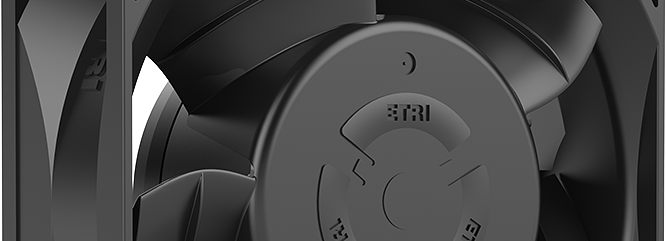
Fans for Thermal Cycling Chambers
How Can You Improve the Safety, Reliability, and Cleanliness of Your Testing?
In a thermal cycling chamber, every component contributes to the quality and repeatability of the tests. Although often considered a simple air circulation device, the fan plays a crucial role in temperature uniformity, thermal transition speed, and the overall reliability of test results.
Choosing the right fan therefore involves much more than selecting the required airflow. Supply voltage, construction materials, mechanical design, and monitoring capabilities all have a direct impact on operator safety, chamber cleanliness, and overall system performance.
24 VAC or 48 VAC Power Supply for Enhanced Safety
Many industrial fans operate on 230 VAC. While this is a common solution, it introduces significant electrical safety considerations, particularly during maintenance and servicing.
By offering compact axial fans powered by 24 VAC or 48 VAC, ETRI significantly reduces the risks associated with mains voltage near the test chamber. This extra-low-voltage solution enhances the safety of both operators and maintenance personnel.
Customizable Housing for Easier Integration
Manufacturers of thermal cycling chambers often require components that integrate seamlessly into their mechanical designs.
Thanks to their flexible construction, ETRI compact axial fans can be supplied with customized housings to meet specific installation and mounting requirements.
Unpainted Aluminum Housing for a Cleaner Test Environment
Thermal cycling chambers repeatedly expose components to alternating low and high temperatures, placing significant stress on all materials.
Fans with painted components may, over time, experience:
- Microcracking of the coating
- Paint flaking
- Particle generation
- Outgassing of volatile organic compounds
These contaminants can settle on test samples, interfere with sensitive measurements, or compromise qualification testing.
To address these challenges, ETRI offers fans with unpainted aluminum housings. Eliminating surface coatings removes the risk of contamination caused by paint degradation and helps maintain a clean test environment—an important advantage for electronics, medical, aerospace, and research applications.
Tachometer Output for Continuous Fan Monitoring
Fan speed has a direct impact on:
- Temperature uniformity
- Heat transfer to test samples
- Test repeatability
A reduction in fan speed can alter chamber performance without being immediately detected.
ETRI fans equipped with a tachometer output enable continuous monitoring of rotational speed directly through the chamber's control system.
This real-time information can be used to verify that the fan is operating within its nominal speed range, allowing users to:
- Detect performance degradation before a failure occurs
- Trigger alarms or preventive maintenance
- Ensure consistent and repeatable test conditions