
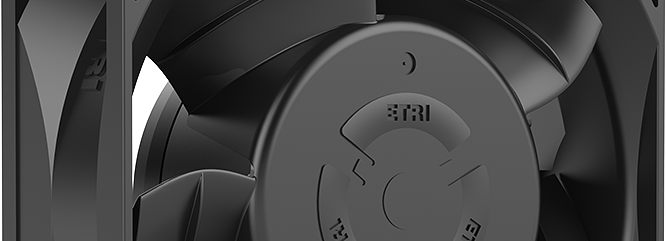
ETRI Axial Fans for Aerospace and Defence
Understanding Internal Rotor and External Rotor Technologies
In the aerospace and defence sectors, the reliability and performance of cooling systems are critical. Onboard equipment—avionics, radars, mission computers, or communication systems—generate heat that must be dissipated efficiently and consistently. The choice of an axial fan therefore becomes a strategic element in designing a reliable system.
At ETRI, we develop several fan technologies adapted to critical environments:
- compact DC external rotor fans,
- compact DC internal rotor fans,
- AC internal rotor fans,
- high-performance DC internal rotor fans.
Each motor architecture offers specific advantages depending on the application. Understanding the difference between internal rotor and external rotor helps in selecting the most suitable fan for aerospace and defence constraints.
Internal Rotor and External Rotor: Two Complementary Architectures
In an internal rotor motor, the rotor rotates at the center of the motor while the stator remains fixed around it. In an external rotor motor, the rotor takes the form of a rotating bell that spins around a central stator.
These two architectures directly influence several key parameters:
- motor torque,
- rotational speed,
- mechanical robustness,
- thermal management,
- and resistance to harsh environments.
This is why the choice of a ventilation solution always depends on the final application.
ETRI internal Rotor Fans: Robustness and Reliability for Critical Applications
ETRI AC fans and high-performance DC fans use an internal rotor architecture, particularly suited to harsh environments encountered in aerospace and defence.
This design offers several major advantages.
Excellent resistance to vibrations and shocks
In an internal rotor motor, the center of gravity is close to the axis of rotation. The bearings are protected inside the motor housing, reducing mechanical stress. This architecture therefore provides very good resistance to vibrations and shocks, in compliance with standards such as MIL-STD-810 or DO-160.
This is a key advantage for equipment subjected to:
- aeronautical vibrations,
- shocks related to military operations,
- mechanical constraints in armored vehicles.
Improved thermal management
The stator, which is the main source of heat in the motor, is in direct contact with the external housing. Heat can therefore be dissipated more efficiently into the equipment structure.
This characteristic is particularly important at high altitude, where thinner air reduces the effectiveness of convective cooling.
Enhanced protection against harsh environments
Internal rotor fans allow the design of motors with a higher protection rating (IP65/IP67). The winding remains protected within a sealed compartment, improving resistance to:
- dust and sand,
- humidity,
- salt fog.
These properties make them an ideal solution for applications such as:
- cooling of avionics equipment,
- ventilation of pressurized bays,
- cooling of mission computers,
- critical onboard systems.
ETRI external Rotor Fans: Compactness and High Torque
ETRI compact DC fans mostly use an external rotor architecture, particularly advantageous when torque and compactness are priorities.
In this type of motor, the rotor bell has a larger radius, which generates high torque at low speed.
Excellent compactness
The motor can be integrated directly into the impeller hub, allowing the design of very compact fans. This feature is useful in:
- drones (UAVs),
- compact onboard electronic systems,
- radar cooling fans.
High efficiency
External rotor BLDC technology offers good energy efficiency and precise speed control, which is an asset in applications requiring optimized energy consumption.
Which Technology to Choose for Aerospace or Defence Applications?
The choice of fan mainly depends on application constraints.
Avionics and onboard electronics cooling
High-performance DC internal rotor fans are preferred. Their mechanical reliability and thermal management make them ideal for critical systems.
Drones and UAVs
Compact DC external rotor fans provide high torque and compactness suited to lightweight platforms.
Ventilation of bays or harsh environments
AC internal rotor fans are suitable thanks to their robustness and resistance to difficult environments.
ETRI Expertise for Critical Applications
Thanks to its expertise in AC technologies (50/60Hz or 400Hz) and BLDC, as well as internal and external rotor architectures, ETRI designs axial fans capable of meeting the requirements of aerospace and defence.
Our solutions are developed to comply with environmental and military standards such as:
- MIL-STD-810 (vibration, dust, shocks),
- DO-160 (aeronautical environment, EMC, temperature, altitude).
This expertise enables us to provide reliable, high-performance cooling solutions adapted to demanding environments, ensuring the operational continuity of critical systems.